

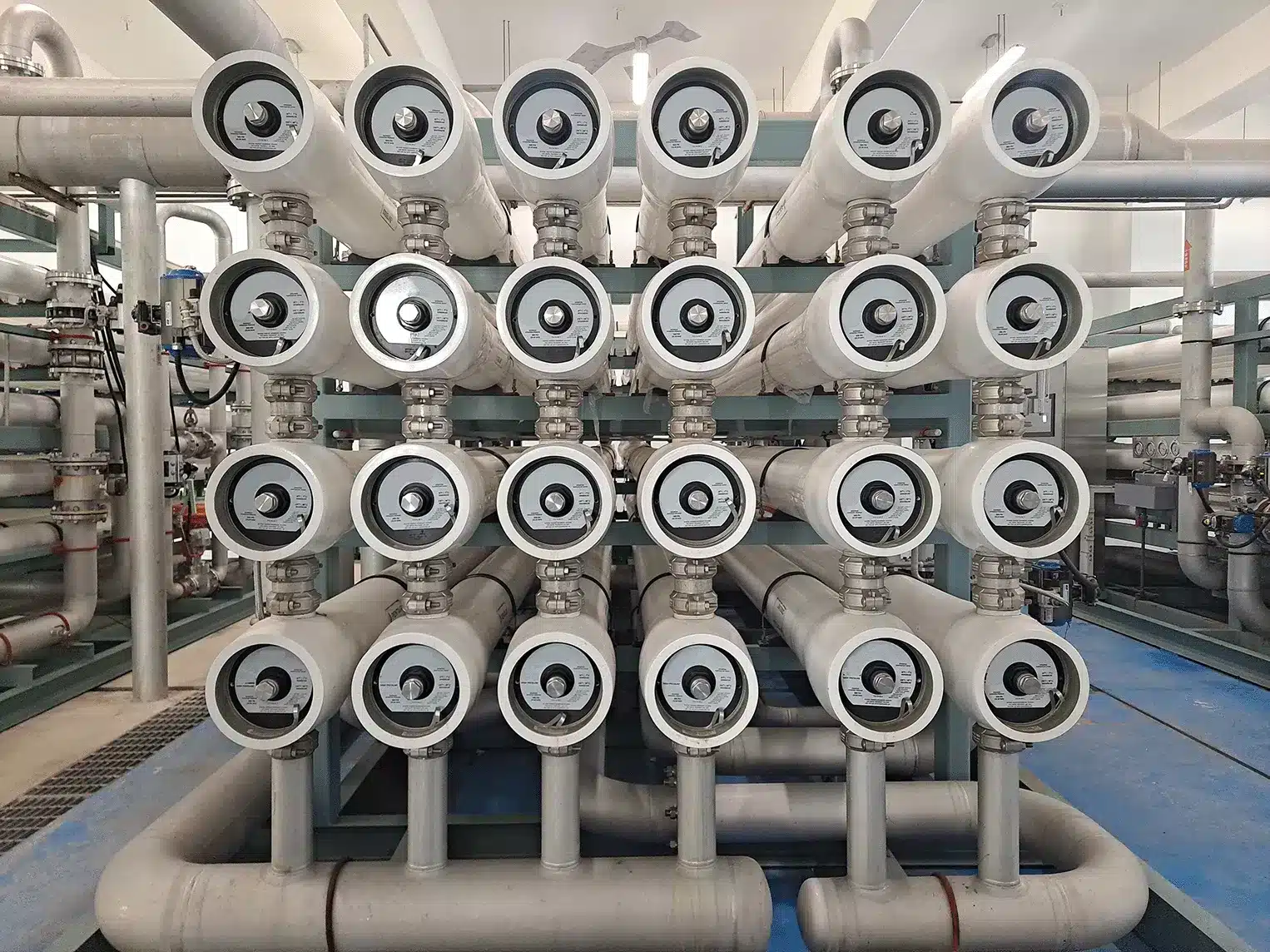
The evolving needs of industry and water recovery technologies require more than just physically filtering water; they also demand the precise separation of dissolved ions within it. Within the range of water treatment technologies, nanofiltration (NF) systems, which occupy a strategic position between ultrafiltration (UF) and reverse osmosis (RO) systems, offer efficient engineering solutions to businesses’ specific treatment requirements.
Nanofiltration is a pressure-driven separation process that uses semi-permeable membranes with an average pore size of 0.001 microns. The key feature that makes this technology unique in industry is that, unlike a system that completely removes all minerals from water (such as reverse osmosis), it offers selective permeability. It retains a high percentage of polyvalent ions such as calcium and magnesium, which cause water hardness, sulfates, color molecules, and pesticide residues, while allowing some monovalent ions such as sodium and chloride to pass through. This provides businesses with the option of “partial demineralization,” creating significant advantages in terms of energy and operating costs.
How Does Nanofiltration (NF) Technology Work?
The industrial nanofiltration device operates based on a combination of molecular weight cutoff and electrical charge (Donnan effect) principles. The water separation process is shaped according to the system’s engineering design:
Removal of Multivalent Ions and Organics
Water delivered to the system by high-pressure pumps behaves as if its molecular size and charge have been analyzed when it reaches the NF membranes. In particular, large ions such as organic substances with molecular weights between 200 and 1000 Daltons, color pigments, and sulfates are strongly repelled by the membrane structure and directed to the wastewater (concentrate) line. In this way, unwanted structural contaminants in industrial process water are blocked by a physical and chemical barrier.
Use as a Water Softening Membrane
As an alternative to classic ion exchange resin water softening systems, nanofiltration technology provides continuous and uninterrupted softening without the need for salt (regeneration process). Thanks to its ability to retain ions that cause hardness, it functions as an environmentally friendly water softening membrane in modern facilities where chemical consumption is undesirable.
Energy Optimization and Efficiency
Reverse osmosis systems require very high operating pressures to remove monovalent ions (such as salt) from water. Nanofiltration, on the other hand, allows monovalent ions to pass through, resulting in a lower osmotic pressure difference. This engineering reality enables pumps to operate at much lower pressures, significantly reducing your facility’s electricity consumption costs (kW/hour).
Industrial and Commercial Applications
NF membrane filter systems form a fundamental infrastructure in sectors where complete demineralization is not required but the removal of specific ions and organic matter is essentiaal:
- Textile and Dyeing Plants: Removal of dyes (colorants) from wastewater and recovery of salt water for reuse in the process.
- Food and Dairy Industry: Concentration of whey, lactose removal processes, and purification of water while preserving specific minerals for beverage production.
- Groundwater and Well Water Treatment: Removal of high sulfate, hardness, and turbidity caused by natural organic matter (NOM) commonly found in well water using a single system.
- Advanced Pre-Treatment for Reverse Osmosis: Specifically designed for seawater desalination plants to reduce sulfate levels and prevent scaling on RO membranes.
Opportunity to Design Projects with Our Professional Team
The success of a nanofiltration system depends on the accurate analysis of the chemical characteristics of the water, the targeted product water quality, and the flow rate requirements. The design of the necessary antiscalant dosages and pretreatment units to prevent membrane fouling is a critical engineering process.
With our expertise and field experience in the water treatment industry, our professional team operates with engineering discipline at every stage of your project. Starting with customized raw water analysis and 3D design processes for your facility, our expert team handles the selection of the appropriate NF membrane type, the coding of automation (PLC/SCADA) software according to your operational scenario, and the commissioning of the system. We ensure the sustainability of your system with our after-sales technical service guarantee, increasing your production quality while reducing your water and energy footprint.
You can contact our engineering team to determine the most suitable advanced filtration technology for your water characteristics and to benefit from our customized design services for your facility.