


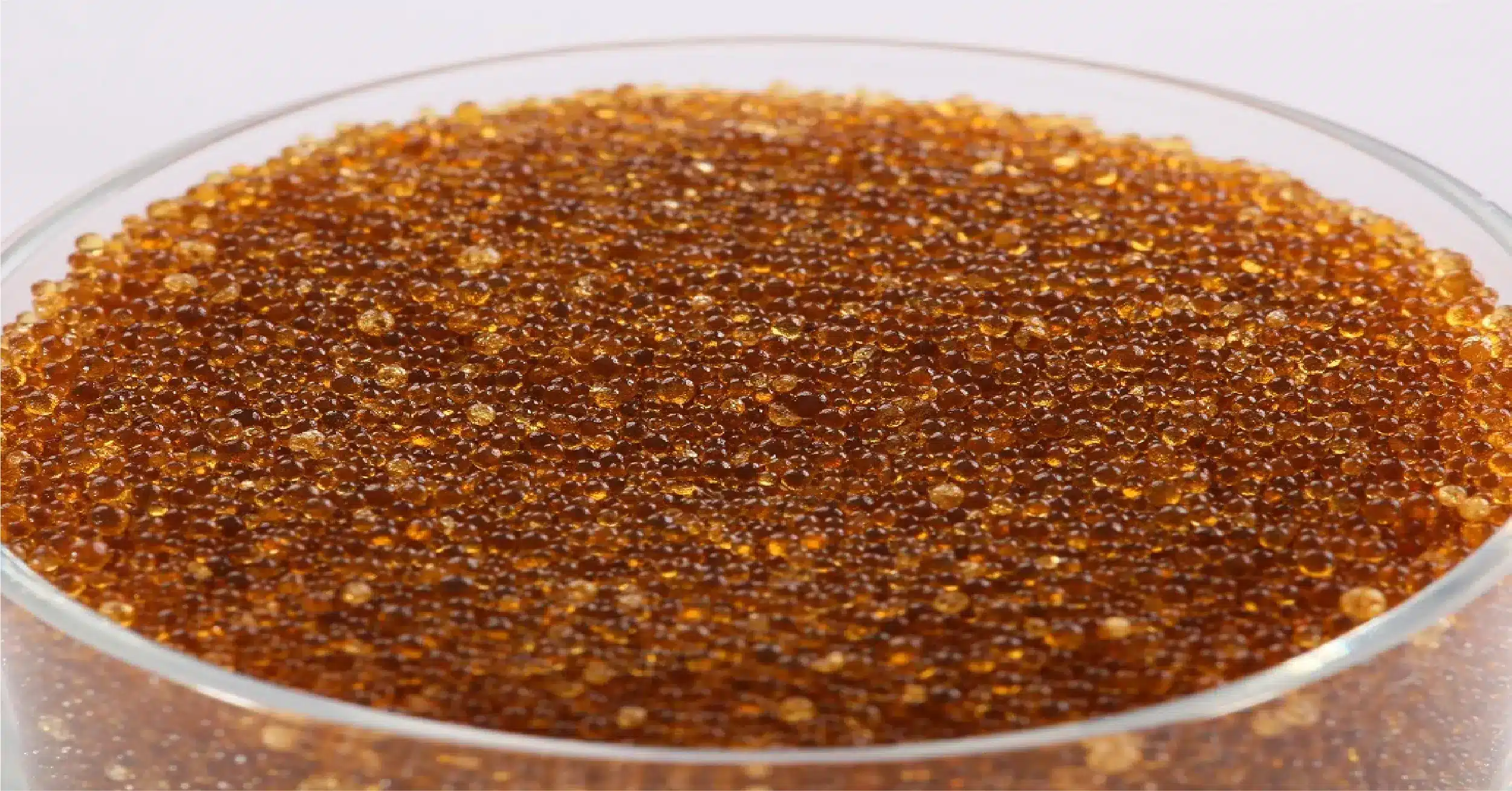
In industrial production lines, boiler rooms, and precision systems, it is not sufficient for the water to be physically clear. Ions such as calcium and magnesium—which are present in dissolved form and cause hardness (scale)—or ions like sulfates and nitrates that increase conductivity must be removed from the water. The most common and efficient media for performing this chemical filtration process are ion-exchange resins.
Produced in the form of polymer-based, microscopic spheres (beads), these resins operate on the principle of “ion exchange” by attracting unwanted ions from the water passing through them while releasing harmless ions back into the water. Depending on the purpose of the treatment system, three main types of resin are extensively used in industry.
Types of Resin Based on Process Requirements
Depending on the electrical charge of the contaminants in the water (whether positive or negative), different types of resin are used in the filter tanks:
Cationic Resins (Water Softening)
It is the most well-known and widely used type of resin in the industry. It binds hardness-causing ions—such as calcium and magnesium, which are positively charged (+) in water—and releases sodium ions into the water in their place. It is primarily used as a standard water-softening resin. When the resin becomes saturated with lime, it regenerates (renews itself) by being washed with brine (sodium chloride) and can be used for years.
Anionic Resins (Demineralization and Nitrate Removal)
It is designed to capture negatively (-) charged ions in water, such as sulfate, nitrate, chloride, and silicate. It is typically used in sequence with cationic resins (in demineralization systems) to remove all minerals from the water. Additionally, special “nitrate-selective” anionic resin models are available for treating hazardous nitrates in well water.
Mixed-Bed Resins (Pure Water Production)
It is used to produce the “ultra-pure water” required by sensitive industries (pharmaceuticals, cosmetics, electronics, and power plants). It is created by homogeneously mixing cationic and anionic resins within the same tank. As water passes through the mixed-bed resin bed, it leaves behind even the last traces of ions, transforming into ultra-pure water with conductivity near zero (typically below 1 µS/cm).
Industrial Benefits
Using the right ion exchange media in your facility provides the following operational benefits:
- Continuous Regeneration: Resins that have reached saturation are washed with salt, acid, or lye to restore them to their original performance. It is not a consumable that needs to be replaced continuously.
- Corrosion and Scale Protection: It provides definitive protection against scaling for your piping systems, expensive production machinery, and steam boilers.
- Precise Conductivity Control: It allows you to reduce water conductivity to your desired microsiemens (µS) value according to your needs.
Over 30 Years of Experience and Our Professional Team
Selecting the right type of resin for your facility, calculating the resin volume (in liters), and integrating regeneration cycles into an automated system requires significant chemical engineering expertise. Substances in water, such as iron, manganese, or free chlorine, can quickly degrade the structure of resins. With over 30 years of engineering and field experience in the water treatment industry, we conduct detailed water analysis and design the optimal pretreatment sequence to protect your resins.
The professional removal of resins from your existing tanks using vacuum systems, the cleaning of in-tank diffusers, and the filling of new resin are all meticulously carried out by our professional team. We ensure your process operates efficiently at all times through the supply of the highest-quality media (resin) and proper valve calibration.
You can contact our team of expert engineers immediately for customized water softening and pure water (demineralization) solutions tailored to your facility.