


In the water and wastewater management of industrial facilities, maintaining system efficiency and meeting legal environmental standards is becoming increasingly important. Very small particles, colloidal substances, and microorganisms that cloud the water and cannot be physically retained by conventional sand or carbon filters pose serious risks for businesses. One of the most reliable engineering solutions developed to combat these challenging contaminants is ultrafiltration systems (UF).
Ultrafiltration is a pressure-driven membrane filtration technology. Water is physically purified of bacteria, viruses, algae, and high molecular weight organic matter through special membranes with pore sizes ranging from 0.01 to 0.1 microns on average. Without altering the chemical composition (minerals) of the water, these systems act solely as a physical and biological barrier, serving as both the main treatment unit and an excellent protective shield prior to advanced treatment in water treatment plant designs.
How Do Ultrafiltration (UF) Systems Work?
At the heart of ultrafiltration technology are membrane modules, which consist of thousands of microscopic tubes (hollow fibers) assembled within a casing. Unlike traditional purification methods, it relies not on a chemical reaction but entirely on the principle of physical filtration:
Hollow Fiber Technology
Water is passed through the surface of capillary tubes within the module under pressure. While water molecules and dissolved ions easily pass through the membrane, suspended solids (SS), bacteria, and particles causing turbidity are retained and cannot pass through the membrane. This technology optimizes energy costs by providing high purification quality even at very low pressures.
Automatic Backwash and CEB System
Contaminants that accumulate on the membrane surface over time must be cleaned periodically to prevent a decrease in system efficiency. In industrial ultrafiltration device designs, this process is achieved through a fully automatic backwash operation. Purified water is fed into the system in reverse at specific intervals to clean the pores. Additionally, the Chemically Enhanced Backwash (CEB) unit, which is periodically activated, extends the membrane’s lifespan and reduces operational costs.
Industrial and Commercial Applications
The flexible structure and high filtration precision of ultrafiltration place it at the center of many critical industrial processes:
- Reverse Osmosis Pre-Treatment: The biggest enemy of membranes in reverse osmosis systems is the contamination load created by water. UF systems smooth out the water before it enters the RO membranes, extending the life of expensive RO membranes for years.
- Surface Water Treatment: Provides physical and microbiological treatment to bring river, lake, or open basin water up to drinking water or utility water standards.
- Wastewater Recovery: It is used as the primary filtration stage in projects where wastewater generated in industrial facilities or treatment plants is made reusable in the process (recovery) instead of being discharged into the environment.
- Food and Beverage Industry: Preserves the natural structure of the product by sterilizing water solely through physical filtration without heat treatment.
Reliable Project Planning with Our Professional Team
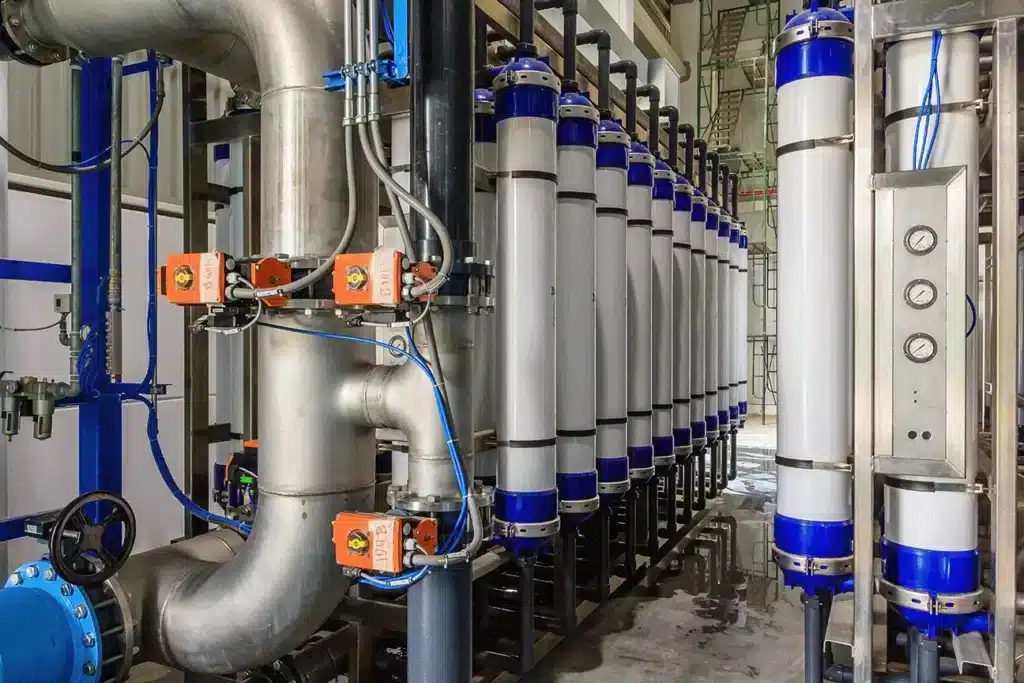
Achieving consistent performance from a UF membrane filter system over many years depends on accurate hydraulic calculations, the right membrane selection, and flawless automation software. Calculating the fouling rate of membranes based on water analysis requires significant engineering expertise.
With our deep-rooted engineering infrastructure in the water treatment sector, our professional team designs the most suitable ultrafiltration scenario for your facility. Our expert staff meticulously carries out the processes of determining the number of modules to be used in both surface water treatment and wastewater recovery projects, integrating CEB and backwash automation into PLC panels, and commissioning the system. We are always by your side with our after-sales technical maintenance support to ensure that your system operates safely, sustainably, and in full compliance with legal regulations.
You can contact our engineering team for ultrafiltration projects that will add value to your process and reduce your water footprint.