


In today’s industrial production facilities, water is not merely a carrier or cleaner; it is a critical component that directly determines the quality of the final product, the lifespan of systems, and energy costs. Ion exchange resins, which remove dissolved minerals from water using a chemical exchange method rather than physical filtration, are one of the most reliable and well-established engineering solutions for obtaining high-purity water.
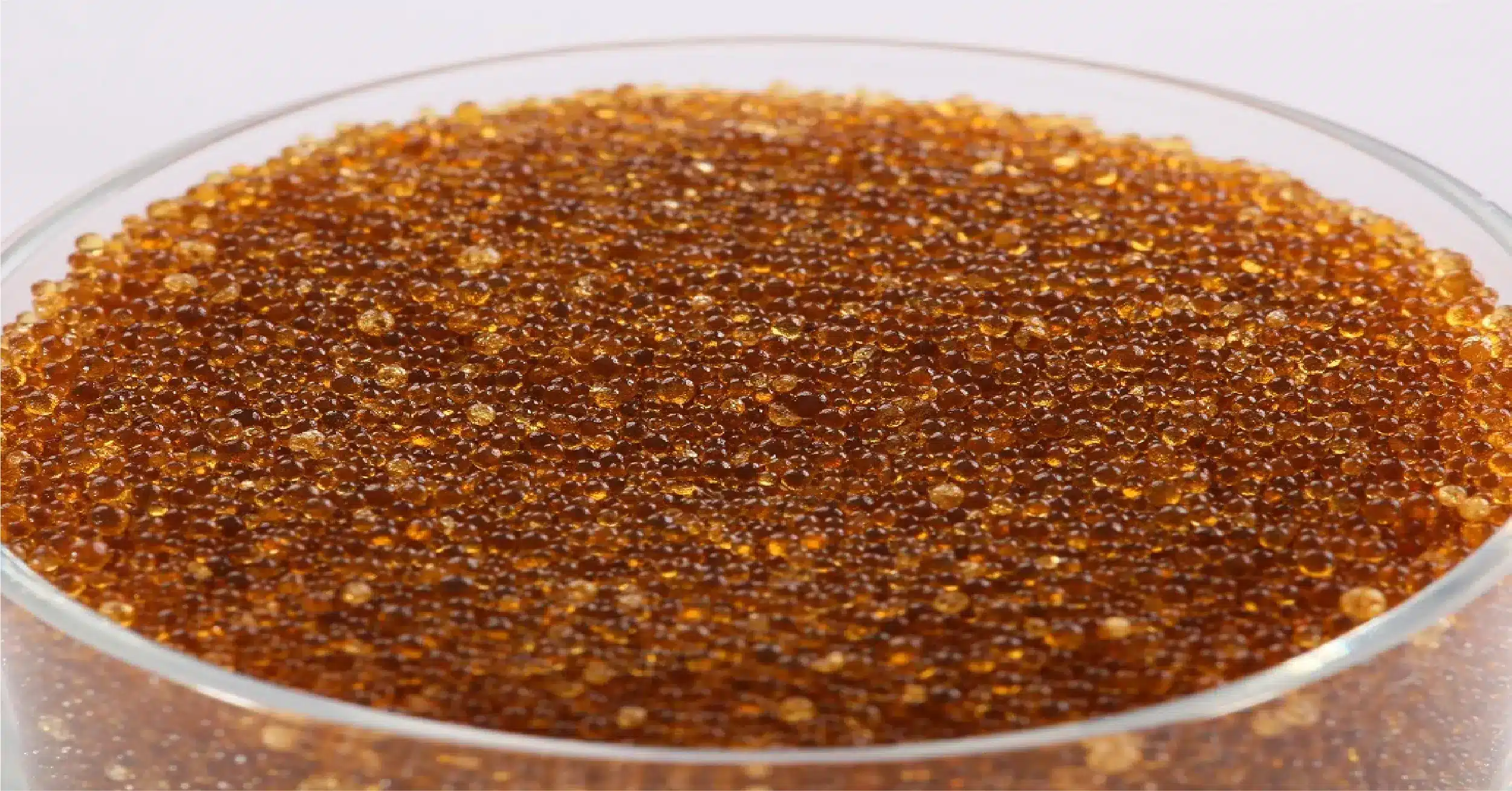
So, what exactly is ion exchange resin, which we often encounter in water treatment technologies? Visually, these polymeric structures resemble small, usually amber-colored plastic beads; they are actually active components that rebuild the chemical character of water at the molecular level. For businesses, this technology is an indispensable investment that eliminates downtime caused by scaling, maximizes heat transfer efficiency, and guarantees the chemical balance of process water.
Ion Exchange Resin Working Principle and Structure
Ion exchange resins operate on a principle that is entirely different from traditional membrane technologies or mechanical filters. While membranes physically pass water through microscopic pores, resins perform a “chemical exchange” (ion exchange) process.
As water passes through the resin bed (tank), weakly bound ions on the resin particles exchange places with stronger or unwanted ions in the water. This process provides a definitive solution to many challenging water problems faced by businesses. For example:
- Calcium (Ca) and magnesium (Mg) ions, which cause hardness, are retained in the resin, while harmless sodium (Na) ions are released into the water.
- This allows the water to be completely softened or deionized (purified) without any pressure loss or production of concentrated wastewater.
This technological superiority makes resins the sole and strongest alternative in sensitive production processes where water conductivity must be reduced to near-zero values.
Types of Ion Exchange Resins Used in Industry
Water chemistry is complex, and the water characteristics required by each facility differ. Therefore, ion exchange resins are classified into different engineering grades based on the electrical charge of the ions they hold. The most commonly preferred resin types according to your facility’s process requirements are as follows:
- Cationic Resins: They are commonly used in industrial water softening systems. They remove hardness from water by targeting positively charged ions (calcium, magnesium, iron). The regeneration process is usually carried out with salt (sodium chloride).
- Anionic Resins: They remove negatively charged ions such as sulfate, nitrate, chloride, and silica from water. They are typically used in sequence with cationic resins to obtain pure water (demineralized water).
- Mixbed Resins: These are systems in which cationic and anionic resins are homogeneously mixed within the same tank. They function as polishing units to minimize conductivity (often below 0.1 µS/cm) in sensitive processes requiring ultra-pure water.
You can visit our Industrial Water Treatment Systems page on our website to explore our system solutions for the right chemical resin configuration tailored to your business.
Critical Areas of Use in Industrial Facilities
Ion exchange resins play an active role in every industry where ionic charges in water could damage the production line or compromise the quality of the final product.
- Boilers and Power Plants: Lime and silica present in boiler feed water solidify at high temperatures, clogging pipes and causing massive energy losses. Resins prevent corrosion and explosion risks by demineralizing the water.
- Pharmaceutical, Cosmetic, and Chemical Industry: The water used in formulations must be neutral and deionized. Resin systems provide ultra-pure water that preserves the product’s shelf life and chemical reaction stability.
- Reverse Osmosis (RO) Pre-Treatment: To prevent membrane systems from becoming clogged with lime (scaling), water softening resins are used prior to RO to extend the operational life of the membranes.
Regeneration, Productivity, and Its Impact on Operating Costs
The biggest advantage of resin-based systems for a business is that they offer a sustainable cost structure. Ion exchange resins are not discarded when they reach saturation (usually); they undergo a regeneration process by being washed with a suitable chemical (salt, acid, or caustic).
A system with resin capacity calculated to match the water flow rate, supported by the right automation valves and dosing pumps:
- Minimizes resin consumption.
- Reduces the amount of chemical used during regeneration (operating expense).
- It operates fully automatically and with high performance for years without requiring a system operator.
In conclusion, resin selection and design in industrial water treatment is a strategic engineering decision that directly impacts your company’s energy bills and production quality. You can contact our expert engineering team to install demineralization or water softening systems that are suitable for your facility’s capacity, long-lasting, and cost-effective.